
The challenge
Townscript is an online DIY event ticketing platform that brings together event organisers and attendees. Townscript wished to understand how they could elevate the user experience for event organisers: how could they reduce the dropout rate, and improve the visibility of their features to make event organisers' event cycle simpler and more rewarding?
As a first step in this direction, it was important to understand the day-to-day event activities of the event organisers as well as their usage of the platform.
Our approach
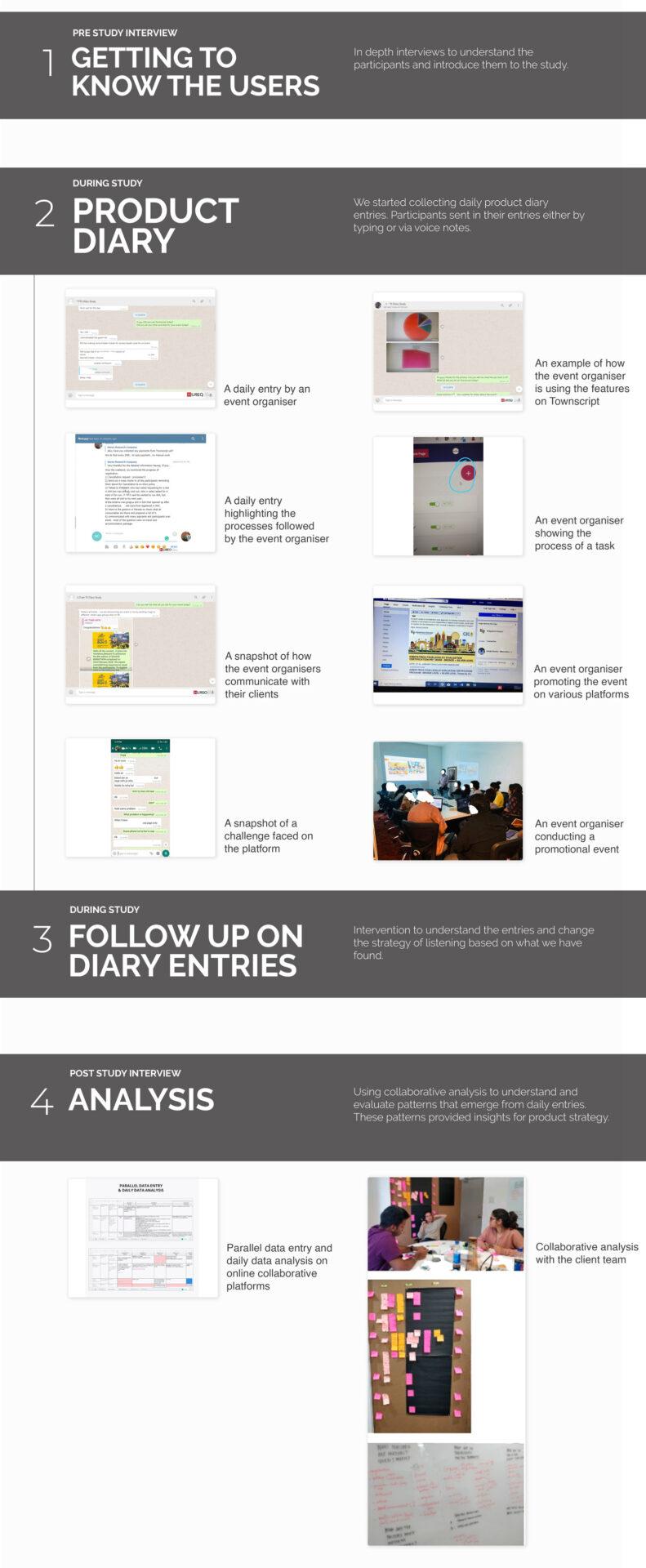
Hureo conducted a diary study to map the day-to-day activities of event organizers both in the online and offline world. In a diary study, users' product diaries are studied to get highly contextual information about user behaviour: what is motivating them to use the product, how they are using it, and what challenges they face.
This approach helped us understand the behaviour of users beyond their usage of the platform, and gave us an end-to-end picture of the environment in which the platform is being used.
It was an intense five-week activity where researchers, product managers, designers and even the founder were deeply involved.
- Getting to know the users: in-depth interviews to understand the participants and introduce them to the study.
- Product diary: we started collecting daily product diary entries. Participants sent in their entries either by typing or via voice notes.
- Follow-up on diary entries: interventions to understand the entries and change the strategy of listening based on what we had found.
- Analysis: collaborative analysis to understand and evaluate patterns that emerged from daily entries. These patterns provided insights for product strategy.
The remote methodology ensured that participants were in their context of use while working on their product diaries. It enabled them to report their feelings, thoughts and challenges connected to event actions as they were experiencing them, which was the goal of the study.
The outcome
Highlighted and prioritized user needs, goals and challenges beyond the platform
- The study helped us understand the entire event cycle of the organizer: the planning, their challenges, stakeholders' involvement at different stages, channels of communication used, and more.
- We also highlighted the motivations of event organizers: why they perform certain tasks, how they feel and think about these tasks, and their perception of the brand in real time.
Created user journey maps to develop a broader service
- The diary study helped to map the flow of activities, along with the frequency of these activities.
- The journey map included details of each activity, prioritization of activities, the tasks within, the methods of completing these tasks, and the associated subtasks, which showed the gaps between current online and offline behaviour.
Identified new opportunity areas to enable an enhanced service
- Understanding the issues faced and how they are being solved provided insights into the unmet needs of event organizers, such as challenges with on-ground activities and poor communication within the ecosystem.
- We highlighted insights and areas of opportunity to guide service strategy and platform redesign.
Identified day-to-day use of the platform to help prioritize features
- The study helped understand the most-used features, the timeline and purpose of their use, and how event organizers used them.